

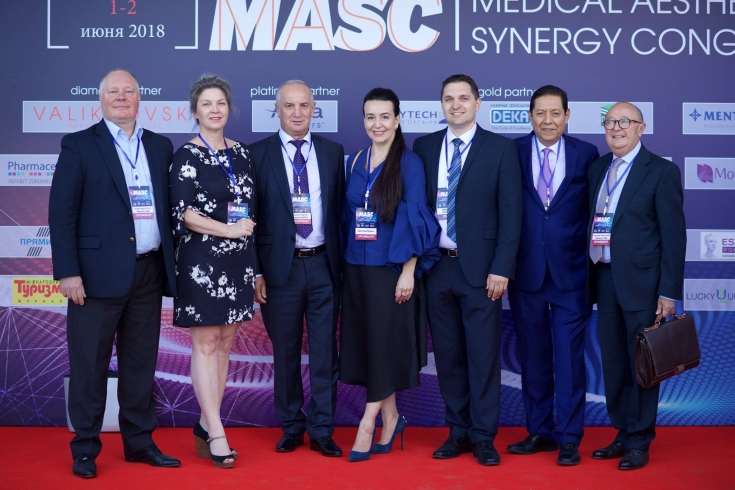
June 1-2, the most authoritative and expected congress for aesthetic medicine professionals took place in Kyiv. The key difference between MASC and other similar events – this is the scientific approach and the level of practical content that the speakers shared with the guests over the course of two days. The estet-portal.com team acted as a media partner of the event and discussed important, interesting and topical issues with the organizers and speakers of MASC. Read in our material an interview with one of the organizers, the President of the All-Ukrainian Association of Plastic Reconstructive and aesthetic surgeons, professor of the department of combustiology and plastic surgery of NMAPE named after L.P. Shupik, Doctor of Medical Sciences – Valisy Pinchuk.
How important is it for a modern physician to participate in activities such as MASC? Receive information from different areas and "be in the know" - is it relevant?
It is important to understand that the entire medical profession involves learning throughout one's professional life. Whether you are a traumatologist, an ordinary surgeon, a plastic surgeon, an esthetician, a dermatocosmetologist - life does not stand still. All new technologies that appear require learning and mastering them.
These are events such as MASC, which are organized all over the world, in different countries, with different frequency, they are just a platform where you can exchange views, where you can hear something new, and, of course, implement these new technologies into your life.
Similar events, such as our today's congress, have been held in Ukraine for about twenty years, with varying frequency and degree of participation. Previously, it was established that plastic surgeons are on their own, dermatocosmetologists are on their own, but over the past five years we have been holding joint events. For example, on today's - there is a whole section on aesthetic dentistry, a section on aesthetic gynecology, and there is also a section on anesthesiology, and patient safety. I would say that we are only expanding. And our activity involves the involvement of all those people who work in this area, so that we understand what our colleagues are doing, so that they know what we are doing, and thus we can rationally, individually select a program for each patient, depending on his needs.
How can you determine whether medicine, in terms of specialist doctors, is moving more towards the doctor knowing and being able to do everything, or is he still a super specialist only in his field?
Actually, medical specialists should know everything. In each area, to have at least some basic knowledge of what and where is happening and where you can refer your patient, depending on the need. In the same way, in our field, which deals with beauty, you need to know and navigate what is being done in other related areas. In order not to be limited to a narrow, only the list of services that the specialist owns. And suddenly something needs to be advised and supplemented. This is what I have already said, a plastic surgeon can make a perfectly beautiful face, but a smile will spoil the whole appearance and then aesthetic dentistry will come to the rescue.
Therefore, it is the addition of knowledge from related fields that enrich the level of each individual specialist. How do you see the future of aesthetic medicine?
I would like to see him happy. (laughs) Of course, technologies do not stand still, some new means, fillers, injections, cell therapy, bioengineering are being invented. And of course, I hope that someday the day will come when, depending on the order of the patient, they will select one or another program on the computer, make some small injection or even without it, inject some kind of chip under the skin without a needle method. , and the human body will develop and rejuvenate as the patient wants.
How relevant do you think information resources are now? Do medical specialists use them, or do they prefer old textbooks or regular printed publications?
What media do they use? Probably, it all depends on the age category, first of all. The older generation is accustomed to using paper media, the new generation – uses digital technologies. Since I am a co-author of about six monographs, I see that less and less they are bought and we have doubts - “Is it worth writing monographs at all?”, Since they lie and are not particularly in demand. It is enough that this monograph fell into the hands of one young specialist doctor, he digitized it, put it on the Internet and, in fact, all the rest of the printed matter lies with the author in the pantry. (laughs) That's the trend.
Information is needed and everyone needs it – this is relevant.
They use more digital technologies. This is probably convenient, because in a small device (points to a smartphone) you can keep a whole library. Plus, we still know this way of finding information as "google". It is very convenient, there is some question, entered it into the search engine and all the information is immediately in front of you. No need to go through catalogs, choose, search. Therefore, the future belongs to digital technologies.
Read more interesting interviews with Medical Aesthetic Synergy Congress on our website estet-portal.com, coming soon.
Share:


Add a comment