

The appearance of visible signs of aging, which lead the patient to a beautician, is preceded by involutional changes in the face at all levels. Accordingly, in order to correctly predict and obtain good results of contouring, a specialist needs to clearly understand which layer of the face and which preparation he will work with. About the possibilities of face correction with fillers based on hyaluronic acid Hydryalix Luminera, taking into account age-related changes in the article estet-portal.com tells Oxana Evgenievna Vanenkova – dermatologist of the highest category, cosmetologist, specialist in minimally invasive techniques of the company «OKK-EXPERT PHARMA COMPANY», Moscow
- Involutional changes in the face: main processes and their aesthetic consequences
- Hydryalix Luminera fillers based on hyaluronic acid for the correction of involutional changes in the face
- Hydryalix Luminera products: indications and recommendations for administration
It is impossible to obtain a satisfactory result of facial rejuvenation with hyaluronic acid-based fillers without a clear understanding of how the aging process proceeds, into which tissue layers drugs should be injected, what characteristics a filler should have to correct a particular area, and what effect can be obtained with his help.
The face consists of 5 main layers:
- leather;
- subcutaneous tissue;
- musculoaponeurotic layer;
- supporting ligaments and spaces;
- deep fasciae, periosteum.
Bone resorption
The aging of the female face is associated with a loss of volume of the facial skull as a result of involution and subsequent descent of the soft tissues.Bone resorption – this is the main involutionary indicator from which the aging process begins long before the appearance of wrinkles, changes in skin texture, volumes that disturb the patient.
Resorption results in displacement of the bone along with the periosteum that covers it.
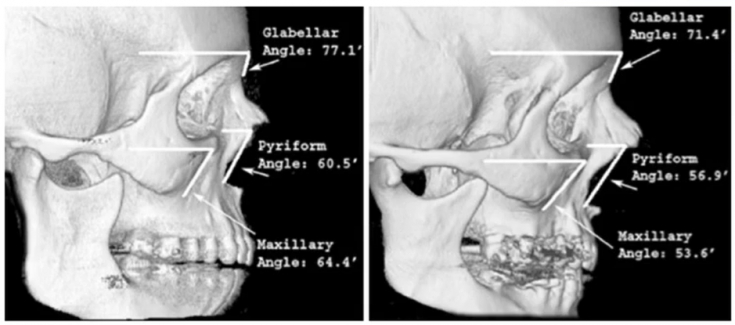
As the bones become thinner, the ligaments attached to them move deeper and downwards, pulling soft tissues behind them at the points of their attachment to the skin. This process entails deepening of wrinkles and furrows, as well as overhanging soft tissues.
When
the dentition is erased, the upper and lower jaws sag, and the projection of the upper jaw decreases. As a result, the middle third of the face is visually displaced posteriorly, even in patients with intact teeth.
During the aging process,significantly decrease:
- pear angle;
- maxillary angle;
- glabellar angle.
Follow us on Facebook!
Age-related changes in muscle tissue
- With age,
- muscle mass decreases, metabolism slows down, fat content increases. Fibrosis
- develops in the muscle tissue , associated with malnutrition and tissue hypoxia due to an age-related decrease in the number of functioning capillaries. Decreased
- levator muscle tone and hypertension of depressor muscles, causing patients to have a sad or dissatisfied face.
Adipose tissue aging
Involutional changes lead to a violation of the homogeneity of the adipose tissue of the face. Under the influence of gravity, the musculoaponeurotic system of the face descends along with its attachment. At the same time, the skin of the face also shifts.The fat compartments move down towards the center of the face, impoverishing the zygomatic area and forming the nasolabial fold and nasolacrimal trough.
You may also be interested in: Two in one: calcium hydroxyapatite and hyaluronic acid filler
Age-related skin changes
The skin in a certain way reflects all the involutional changes that occur in the remaining layers of the face, namely:
- the severity of wrinkles and folds increases;
- skin relief becomes uneven;
- indicators of firmness and elasticity decrease;
- swelling appears;
- deformations occur.
Approximately 50% of hyaluronic acid (
HA) is known to be found in the skin. Being an integral part of the extracellular matrix, this substance:
- contributes to maintaining the water balance of cells,
- activates the work of fibroblasts,
- stimulates skin regeneration.
The line of
Hydryalix Luminerafillers based on hyaluronic acid includes sterile, homogeneous biodegradable preparations of various viscosity grades. They are for:
- correction of wrinkles and skin folds;
- replenishment of soft tissue volumes;
- simulation of different zones.
Composition of fillers Hydryalix:
- non-animal derived sodium hyaluronate (20 mg/mL, 1.9 MDa) with the same degree of crosslinking;
- BDDE – crosslinking agent;
- phosphate buffer, pH 7.3.
How the degree of modification affects the HA gel:
As the crosslink density of the gel increases, the distance between the crosslinked segments decreases. Thus, more force is required to break the bond and the biodegradation period is increased.
InnovativeIonic Technology Hybrid MoBiTM
- A monophasic gel is first created with 100% BDDE-crosslinked hyaluronic acid.
- Then is the "cutting" structure of the resulting gel into particles of the required size, which ensures the creation of drugs for various indications.

In order to choose the right filler based on hyaluronic acid for the correction of a particular zone, it is important to consider: the larger the particles, the more pronounced the volumizing effect will be.
Injection Zones Hydryalix Luminera:
- forehead;
- bridge;
- crow's feet;
- nose;
- cheekbones;
- nasolabial folds;
- oral commissures;
- puppet wrinkles;
- lips;
- jaw line;
- chin;
- Back of hand.
Benefits of Hydryalix fillers:
- properties of monophasic and biphasic gels (due to Hybrid MoBiTM technology);
- gel density allows you to create the necessary shapes and volumes, ensure the duration of the effect;
- minimal risk of edema and Tyndall effect;
- drugs of choice for patients with age-related ptosis and a tendency to edema;
- Volume of drug 1.25 ml in each syringe;
- are available in two versions – without anesthetic and with 0.3% lidocaine;
- best value for money
- .
Each Hydryalix Luminera package contains: 2 disposable syringes of 1.25 ml, ergonomically shaped for ease of administration and dosing of the drug; thin-walled needle TSK 27G in a blister pack with a syringe; instructions for use and stickers with information about the drug.
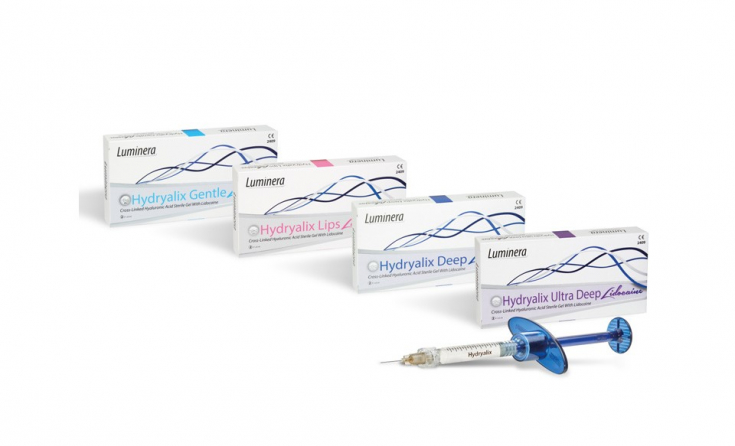
- Hydryalix Gentle
Indications for use:
- filling superficial, fine and moderate wrinkles;
- slight sagging of the skin;
- correction of crow's feet and purse-string wrinkles;
- lip contour correction;
- filling of the nasolacrimal trough.
Injection level; superficial and middle layers of the dermis.
Biodegradation period: 6–9 months. It stays in the nasolacrimal sulcus for a year and in some cases up to 1.5 years.
Needles and cannulas
for insertion: needle 27–30G, cannula depends on the insertion site. In hazardous areas – 22–25G.Hydryalix
- Volume Indications for use:
correction of medium and deep wrinkles;
- lip augmentation;
- restoration of facial contours.
- Injection level
Contraindicated: for injection around the eyes.
Recommended needles
25–27G andcannulas22–25G. Hydryalix
Deep- Indications for use:
correction of deep wrinkles and skin folds (nasolabial folds, marionette lines); face and body modeling (cheekbones, chin, lower jaw line).
-
Injection level
- : deep dermis, supraperiostally.
Recommended cannulas
22–25G andneedles 25–27G.
Read also: Innovation, efficiency, reliability: 3 reasons to choose a plasma machine
- Indications for use: correction of pronounced deep wrinkles and folds of the face and body (nasolabial folds, marionette lines); face and body modeling (cheekbones, chin, lower jaw line).
Injection level
: deep dermis, subcutaneous, supraperiostally.- : 8-12 months.
- for injection in the area around the eyes, between the eyebrows, lips, around the mouth.
Recommended cannulas
22–25G andneedles 25–27G.
Hydryalix products from the exclusive distributorOKK-EXPERT PHARMA COMPANY
have all the advantages of monophasic fillers – plasticity and uniformity of distribution, reduced risk of edema and the Tyndall effect, as well as biphasic preparations (gel density allows you to create the necessary tissue volumes and ensures the duration of the effect).You can use any technique to administer Hydryalix fillers. Main – follow the recommendations regarding the injection layer of a particular drug. More interesting videos on our
YouTube
Share:


Add a comment